
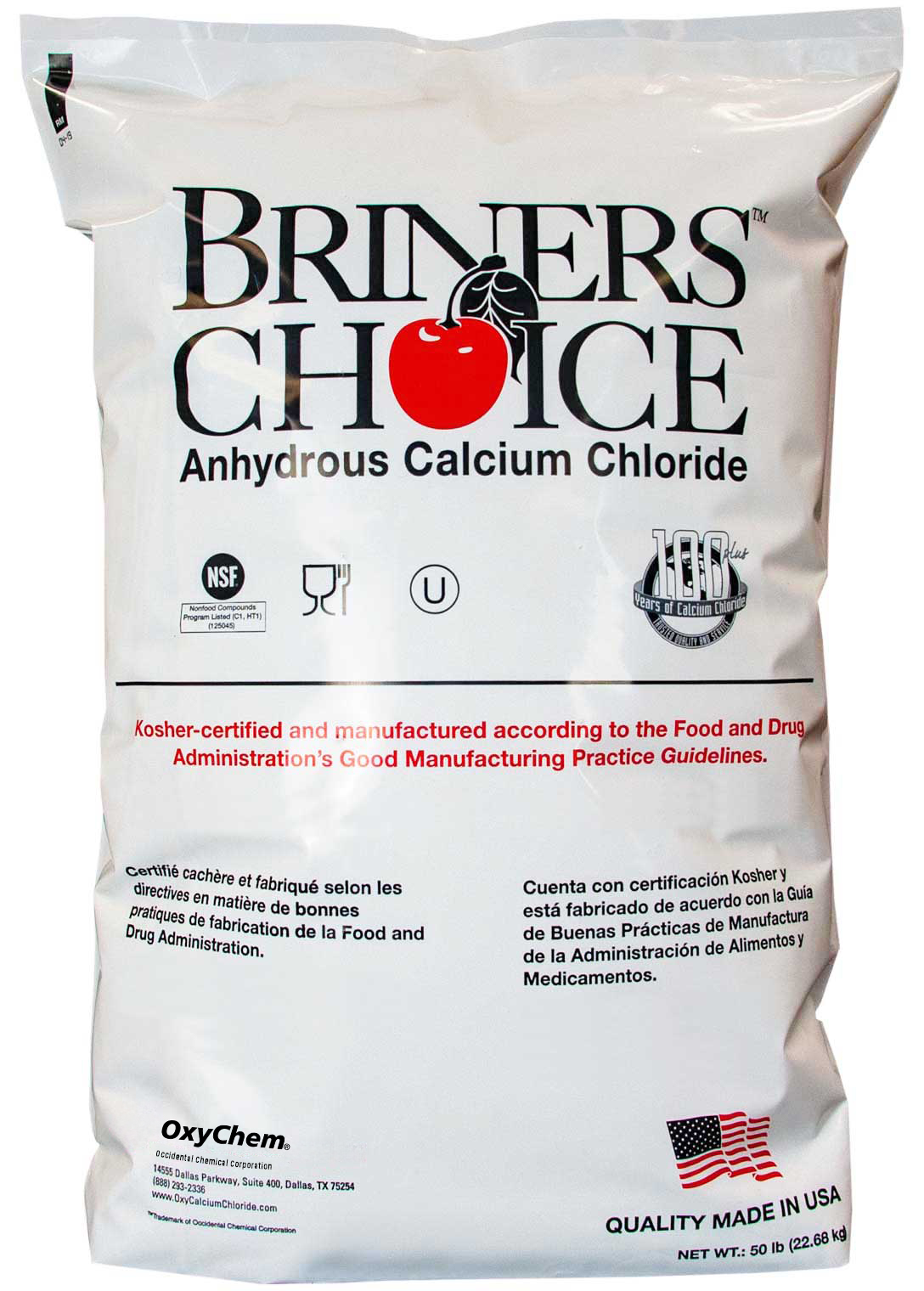
BRINERS CHOICE® Anhydrous Calcium Chloride Pellets

Product Description
BRINERS CHOICE Anhydrous Calcium Chloride Pellets are white, free-flowing pellets that are manufactured according to the U.S. Food and Drug Administration’s (FDA) current Good Manufacturing Practice (cGMP) requirements. This product is Kosher certified and Halal compliant. A Certificate of Analysis (COA) is provided for every product shipment.
BRINERS CHOICE is intended for use in solution form. After dissolving in potable water and filtering to remove insoluble residue, solutions made from BRINERS CHOICE will meet the Food Chemicals Codex monograph for calcium chloride solutions.
To create a solution by mixing this product with water, refer to our Making Solutions Calculator.
Where To Use

Food Processing

Storage & Shelf Life
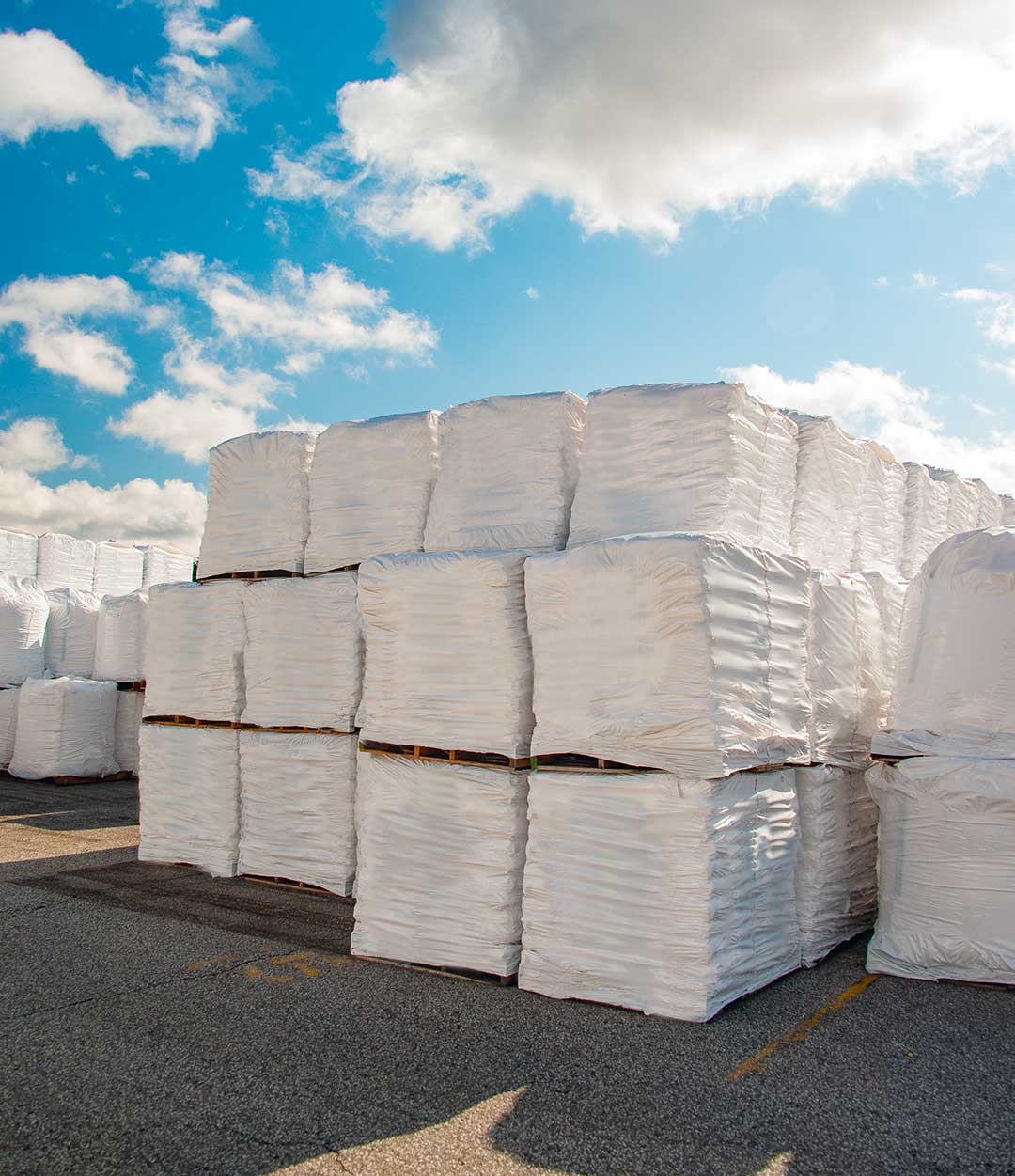
Store in a dry area, and tightly reseal after each use. To maintain product quality while in storage, solid calcium chloride must be protected from moisture. If the product is on a pallet covered by an intact plastic shroud, it can be stored outdoors on a well-drained surface. If the shroud is torn, pierced, or removed, then the palletized product should be stored indoors or under a waterproof covering.
When properly stored to protect from moisture contact, the expected shelf life for all calcium chloride packaged products is 36 months from the date of manufacture. Calcium chloride does not degrade or deteriorate; however, the shelf life is limited based on the potential for moisture intrusion into the product. Moisture will cause a decrease in overall calcium chloride assay and may cause product clumping. Solid calcium chloride absorbs moisture from the air (i.e., is hygroscopic), even to the point of converting to liquid brine (i.e., is deliquescent).
For more detailed information see our Calcium Chloride Handbook.
BRINERS CHOICE® FAQs
First, determine the amount of dry calcium chloride to mix with water using our helpful Making Solutions Calculator tool.
Always start with cool water and add the solid calcium chloride slowly to the water while continuously mixing. Significant heat is released when dissolving solid calcium chloride, and a temperature increase will occur. For example, when dissolving DOWFLAKE® Xtra 83-87% Calcium Chloride Flakes while making up a 30% solution, the temperature can be expected to increase almost 84°F.
If solids are allowed to sit motionless while in contact with water, a hard cake will form that will be slow to dissolve.
Pure calcium chloride is 36.1% calcium. To determine the amount of calcium in a calcium chloride product, simply multiply the calcium chloride concentration by 36.1%. The typical calcium concentration of certain products is included in the table below:
Calcium Content of OxyChem Products |
||
|
Product |
Calcium Chloride |
Calcium |
| Anhydrous Calcium Chloride 94-97% Mini-Pellets |
>94% |
>34% |
| BRINERS CHOICE® Anhydrous Calcium Chloride Pellets |
>93.0% |
>33.6% |
| DOWFLAKE® Xtra 83-87% Calcium Chloride Flakes |
>83% |
>30% |
| Food Grade Anhydrous 94-97% Calcium Chloride Pellets |
93.0 – 100.5% |
33.6 – 36.3% |
| LIQUIDOW® Food Grade Calcium Chloride Solution |
32.0 – 33.0% |
11.6 – 11.9% |
Calcium Chloride
>94%
Calcium
>34%
Calcium Chloride
>93.0%
Calcium
>33.6%
Calcium Chloride
>83%
Calcium
>30%
Calcium Chloride
93.0 – 100.5%
Calcium
33.6 – 36.3%
Calcium Chloride
32.0 – 33.0%
Calcium
11.6 – 11.9%
The pH reading for an undiluted sample of 35% solution is approximately 9. OxyChem calcium chloride products are alkaline due to the presence of a slight calcium hydroxide impurity.
Accurate and consistent pH measurement in concentrated salt solutions can be challenging. Results vary depending on the pH probe used and the degree of sample dilution.
Store product in a dry area, and tightly reseal after each use. To maintain product quality while in storage, solid calcium chloride must be protected from moisture. If the product is on a pallet covered by an intact plastic shroud, it can be stored outdoors on a well-drained surface. If the shroud is torn, pierced, or removed, the palletized product should be stored indoors or under a waterproof covering.
For additional information, see our Calcium Chloride Handbook.
If lightly caked, the product may be broken up by knocking the closed package against a hard surface, like breaking up a bag of ice. If the caked product is too hard to break apart, the product is, unfortunately, unusable and should be disposed of according to guidance on the product label. DO NOT TRY FORCEFUL HAMMERING TO BREAK THE PRODUCT APART. FLYING PRODUCT PIECES MAY BE AN EYE HAZARD.
When properly stored to protect from moisture contact, the expected shelf life for solid calcium chloride products is 36 months from the date of manufacture. Calcium chloride does not degrade or deteriorate; however, the shelf life is limited based on the potential for moisture intrusion into the product, which may cause product clumping. Solid calcium chloride absorbs moisture from the air (i.e., is hygroscopic), even to the point of converting to liquid brine (i.e., is deliquescent).
OxyChem issues Certificates of Analysis only for the following specialty products:
Food Grade Anhydrous 94-97% Calcium Chloride Pellets
BRINERS CHOICE® Anhydrous Calcium Chloride Pellets
PELADOW® DG Calcium Chloride Briquettes
LIQUIDOW® Food Grade Calcium Chloride Solution
Download a copy of the current kosher certificate for all OxyChem food grade calcium chloride products.
Yes. Please Contact Us for details.
Yes. Located in Ludington, Michigan, the facilities associated with the manufacture and packaging of OxyChem's food grade calcium chloride products undergo an annual audit of Good Manufacturing Practices and Food Safety Systems conducted by a reputable, independent auditor.
Download the current copy of the audit certificate.
Yes. Please refer to the applicable product pages for the following food grade products:
BRINERS CHOICE® Anhydrous Calcium Chloride Pellets
Food Grade Anhydrous 94-97% Calcium Chloride Pellets
LIQUIDOW® Food Grade Calcium Chloride Solution
No. OxyChem calcium chloride products are not certified per NSF/ANSI 60, Drinking Water Treatment Chemicals; or NSF/ANSI 61, Drinking Water System Components.
No. OxyChem recommends against using our calcium chloride in drinking water applications due to the presence of impurity bromide. Bromide can react with oxidizers used for water sterilization to form bromate. In many countries, drinking water standards restrict bromate to very low levels. These standards may not be met if drinking water is treated with our calcium chloride and sterilized with oxidizing chemicals, such as ozone.